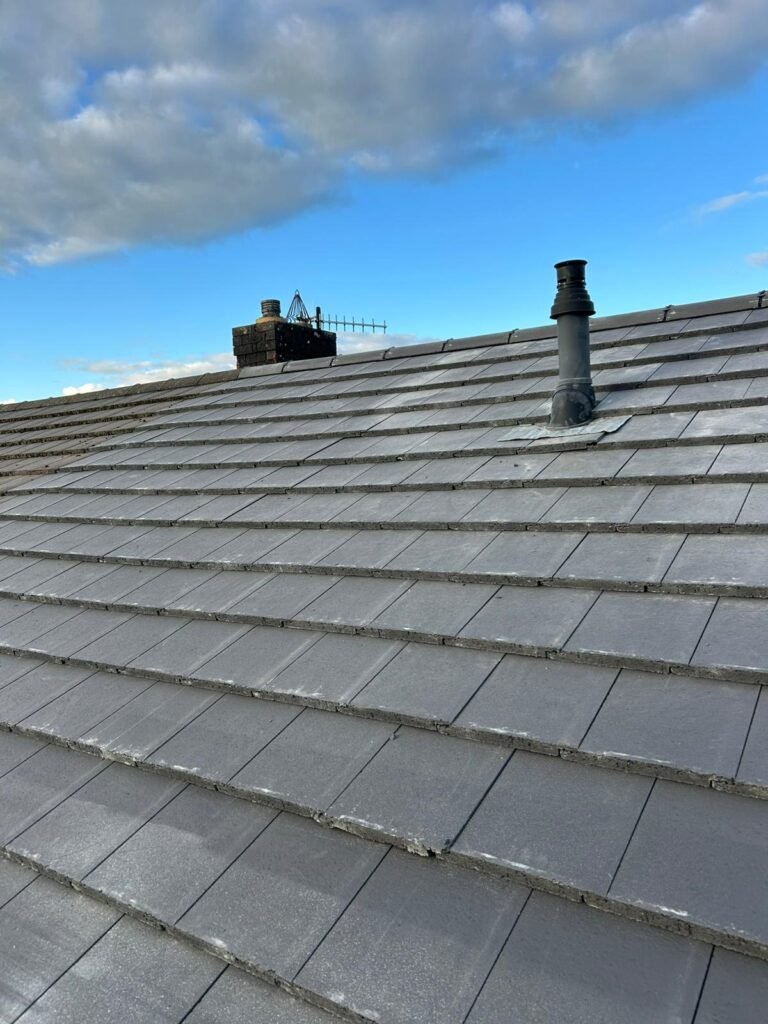
A new roof in County Durham costs between £4,000 and £16,000 in 2026, depending on property type and material. A mid-terrace re-roof typically runs £4,000–£7,000, a three-bed semi £6,500–£10,500, and a four-bed detached £9,500–£16,000. Prices include scaffolding, strip-off, new battens, membrane and VAT.
Roofing prices in the North East sit noticeably below the national average, which is good news if you live in Bishop Auckland, Durham, Darlington or anywhere across the county. Below you’ll find the full breakdown: cost by property type, cost per square metre by material, what a proper quote should include, and the extras that catch homeowners out.
New Roof Cost in County Durham by Property Type
Roof price tracks roof area, not floor area and roof area is usually 20–40% larger than the footprint of the house beneath it, depending on the pitch. That’s why prices are grouped by property type.
The figures below are for a full strip and re-cover in concrete interlocking tiles, including scaffolding, waste removal, new battens, breathable membrane, labour and VAT.
| Property type | Typical roof area | County Durham cost (2026) | Midpoint |
| Mid-terrace (2–3 bed) | 40–55 m² | £4,000 – £7,000 | £5,500 |
| End-terrace (2–3 bed) | 45–60 m² | £4,800 – £8,000 | £6,400 |
| Semi-detached (3 bed) | 60–85 m² | £6,500 – £10,500 | £8,500 |
| Bungalow | 70–100 m² | £6,000 – £10,000 | £8,000 |
| Detached (4 bed) | 90–130 m² | £9,500 – £16,000 | £12,500 |
| Large or complex detached | 130 m² + | £16,000 – £25,000+ | — |
Terraced properties have the smallest roof area but can be the trickiest to price. Rear access is often restricted, and on a mid-terrace the scaffold has to be threaded down a shared alley or brought through the property. If a neighbour is re-roofing at the same time, sharing the scaffold hire can save both households a few hundred pounds.
Semi-detached houses are the most common re-roof we carry out across Bishop Auckland and the wider county. A standard three-bed semi with a simple gable roof is the most predictable job of the lot.
Detached properties sit at the top of the range because the roof is bigger and more cut up. Every hip, valley, dormer and chimney adds labour, leadwork and detailing time. A complex roof shape can add 15–30% to the effective rate.
New Roof Cost per m² by Material
If you want to sanity-check a quote quickly, work in cost per square metre. These are typical County Durham supply-and-fit rates for 2026, including membrane, battens and scaffolding on a normal 50–90 m² roof.
| Roofing material | Cost per m² (fitted) | Expected lifespan |
| Concrete interlocking tile | £65 – £110 | 40–60 years |
| Fibre cement / synthetic slate | £75 – £115 | 30–50 years |
| Clay plain tile or pantile | £90 – £155 | 60–100 years |
| Spanish natural slate | £110 – £190 | 60–80 years |
| Welsh natural slate | £155 – £275 | 80–100+ years |
| EPDM rubber (flat sections) | £50 – £85 | 25–35 years |
| GRP fibreglass (flat sections) | £65 – £100 | 25–30 years |
Two things to watch when you multiply up.
Small roofs carry a minimum-job premium. Below roughly 30 m², expect the top of every range — setup, access and waste costs don’t shrink just because the roof does.
The covering usually outlives the roof underneath it. Slate can last a century, but the battens, membrane and fixings beneath it generally need replacing at 40–60 years regardless. That’s why a “the slates are still fine” roof can still need stripping and re-laying.
What Should Be Included in a New Roof Quote?
A complete re-roof quote in County Durham should itemise all of the following. If any line is missing, ask why before you sign.
- Erecting and hiring scaffolding, with public liability cover
- Stripping the existing tiles, battens and felt
- Skip hire and waste disposal
- New breathable underlay membrane
- New treated timber battens to BS 5534 standard
- New tiles or slates, supplied and fitted
- Ridge and hip tiles, mechanically fixed via a dry ridge system
- New lead flashings to chimneys, abutments and valleys
- Making good, site clean-down and a written guarantee
Anything not on that list is an extra. That’s not necessarily a problem — it just needs to be visible before work starts, not discovered halfway through.
Extra Costs That Change the Final Price
These are the line items that most often move a quote between the survey and the invoice.
| Additional work | Typical County Durham cost |
| Scaffolding (3-bed semi, 2–3 weeks) | £650 – £1,500 |
| Skip hire and waste disposal | £250 – £450 |
| Replacing rotten rafters or sarking | £400 – £2,500+ |
| New lead flashing around a chimney | £350 – £900 |
| Chimney repointing while scaffold is up | £400 – £1,200 |
| Dry ridge system (per linear metre) | £45 – £70 |
| New fascias, soffits and guttering | £1,200 – £2,800 |
| Loft insulation upgrade (Part L) | £400 – £1,200 |
| Fitting a new rooflight or Velux | £900 – £1,800 each |
The single biggest saving available: if your fascias, soffits or guttering are also tired, do them at the same time as the roof. You only pay for the scaffold once, which typically saves £700–£1,500 versus booking the work separately a year later.
The biggest unknown: nobody can see the condition of the timbers until the covering comes off. A good roofer will tell you that honestly and give you a rate for timber repairs upfront rather than pretending it can’t happen.
Why Are Roofing Costs Lower in County Durham?
Roofing materials are priced nationally, a pallet of concrete tiles costs much the same in Durham as it does in Dorking. The regional gap comes almost entirely from labour rates and scaffold hire.
The North East runs roughly 15–22% below the UK national average for a like-for-like re-roof. London and the South East run 20–30% above it. A job quoted at £8,500 in Bishop Auckland could comfortably be £13,000 in Surrey for identical work and identical materials.
That regional advantage is real, but it cuts both ways: a quote that comes in dramatically below local market rates usually means corners are being cut somewhere you can’t see — membrane grade, batten compliance, or scaffold insurance.
Building Regulations That Affect What You Pay
Two rules catch homeowners out on re-roofing jobs.
The 25% rule (Building Regulations Part L). If you replace more than 25% of a roof’s surface area, you’re required to upgrade that roof’s thermal insulation to current standards. On most County Durham properties this means topping up loft insulation, which adds £400–£1,200 to the project. It also means a full re-roof is notifiable work — your roofer either notifies Building Control or is registered under a competent person scheme.
Mechanical fixing (BS 5534). Since the 2014 revision of BS 5534, ridge and hip tiles can no longer be held on with mortar alone. They must be mechanically fixed, which in practice means a dry ridge system. If a quote still specifies a mortar-bedded ridge with no mechanical fixing, the work will not meet current standards.
If your property is listed or sits in a conservation area — and parts of Durham city, Bishop Auckland and Barnard Castle do — you may also need consent, and may be required to match the original material. Welsh slate on a period property instead of concrete tile can easily double the covering cost.
How to Estimate Your Own Roof Area
You can get a rough figure in two minutes:
- Measure the footprint of your house — length × width in metres.
- Multiply by a pitch factor: 1.1 for a shallow roof, 1.2 for a standard pitch, 1.4 for a steep roof.
- Add the area of any extensions, dormers or garage roofs separately.
- Multiply the total by the £/m² rate for your chosen material from the table above.
A 9m × 8m semi with a standard pitch works out at 9 × 8 × 1.2 = 86 m². At £65–£110/m² for concrete tile, that’s roughly £5,600–£9,500 — which lands squarely in the semi-detached band above.
Use this to sense-check a quote, not to replace a survey. Only a roofer on a ladder can tell you the condition of the flashings, valleys and timbers.
Should You Repair or Replace?
A repair is almost always the cheaper and correct choice when the damage is localised — a handful of slipped tiles, one failed flashing, a single leaking valley — and the rest of the roof is sound.
Replacement becomes better value when:
- The roof is 40+ years old and has never been stripped
- Repairs are becoming an annual event
- More than about a quarter of the covering is affected
- The battens or membrane have failed, not just the tiles
- The ridge line is visibly sagging or dipping
Roughly speaking, once you’re spending more than about a third of the replacement cost on repeated repairs, you’re renting a roof rather than owning one.
How to Compare Roofing Quotes Properly
Get three written quotes from established local roofers. Identical work can vary by 30–40% between contractors, so a single quote tells you nothing about whether you’re being treated fairly.
When they arrive, check that all three cover:
- The same material and the same grade of membrane
- Whether scaffolding is included or excluded
- Whether waste disposal is included
- What happens if timber repairs are needed, and at what rate
- The length and terms of the workmanship guarantee
- Insurance cover and any trade accreditations
The cheapest quote is only the best quote if it’s for the same job.
Get a Fixed Quote for Your Roof in County Durham
Every figure on this page is a guide. The only number that matters is the one on a written quote after someone has been up and looked at your roof.
Prestige Roofing is based in Bishop Auckland and works across Durham, Darlington, Sunderland, Middlesbrough, Chester-le-Street, Consett, Peterlee, Seaham, Spennymoor, Stanley, Washington, Sedgefield and Newton Aycliffe. We offer free roof inspections and fixed, itemised written quotes with no obligation.
Call 0800 206 2370 or request your free quote online.